
Central Louisiana Juvenile Releases
The Central Louisiana Juvenile Detention Center belongs in Catahoula Parish's facility map because the regional authority serves the parish. That does not make juvenile custody a public adult release list. A child may leave detention under a juvenile court order, placement decision, transfer, or another authorized disposition. Those outcomes depend on the individual case. Public-facing adult roster logic should not be used to guess which event occurred.
Juvenile records are generally protected. The proper confirmation comes from an authorized communication by the center, the juvenile court, counsel, or another official participant in the case. A child's absence from a website does not show release, transfer, or case outcome. No names, images, dates of birth, charges, or other identifying details should be pursued through an adult released-inmate workflow.
Confirm Central Louisiana Juvenile Release
The correct route depends on the requester's legal relationship to the child and the authority governing the case. An authorized parent or guardian may receive different information from a member of the public. Counsel can request and interpret court or facility records within the rules of the proceeding. Keep case numbers and official notices private while seeking help.
- Confirm that the child is connected to Catahoula Parish and the regional juvenile authority, not an adult parish or state facility.
- Gather the juvenile case number and proof of the requester's authorized relationship, if those items have been lawfully provided.
- Contact the detention center or juvenile court through the channel already supplied in the case paperwork.
- Ask counsel which custody, placement, or release details may be shared and which record provides formal confirmation.
- Do not search adult rosters, mugshot sources, or public release lists for a child.
The Louisiana Public Defender District 7 office is a verified district-level route for defense information in protected juvenile matters. It is not a public custody database and should not be asked to disclose a child's private record to an unauthorized caller.
Central Louisiana Juvenile Contacts
The project research did not verify a public release-record line, street address, office hours, or online search for the center. Inventing those details could route a family to the wrong place or expose a protected matter. Use contact information from current court papers, counsel, or an official agency directory. Ask the receiving office to verify that it serves the child's case before sharing any identifying facts.
Use the official contact supplied in the juvenile case.
Catahoula matters fall within Louisiana Public Defender District 7.
Official District 7 office page
If a parent or guardian lacks paperwork, the juvenile court or counsel can explain the authorized access route. The Catahoula Parish Clerk's adult criminal search is not automatically the correct place for a juvenile file. Privacy rules can restrict even the existence of a case. Staff may need to verify identity and legal authority before discussing custody or release.
Use only contact details found on a current official page or in the case documents. Do not send a child's name, birth date, or case information to a number copied from an unofficial directory. When an office cannot discuss the matter, ask which official channel handles identity verification rather than pressing for facts in an open call or email. The restriction protects the child and does not imply a particular custody outcome.
Central Louisiana Juvenile Authority
Louisiana Revised Statutes Title 15 contains the legal framework for the regional authority. Research identified R.S. 15:1094.1 as the provision covering an authority that serves Avoyelles, Catahoula, Concordia, Grant, LaSalle, Vernon, and Winn Parishes. Regional service means a Catahoula case may be handled outside the parish while remaining tied to its juvenile court process.
The official Title 15 law table documents the statutory source for this regional juvenile authority.
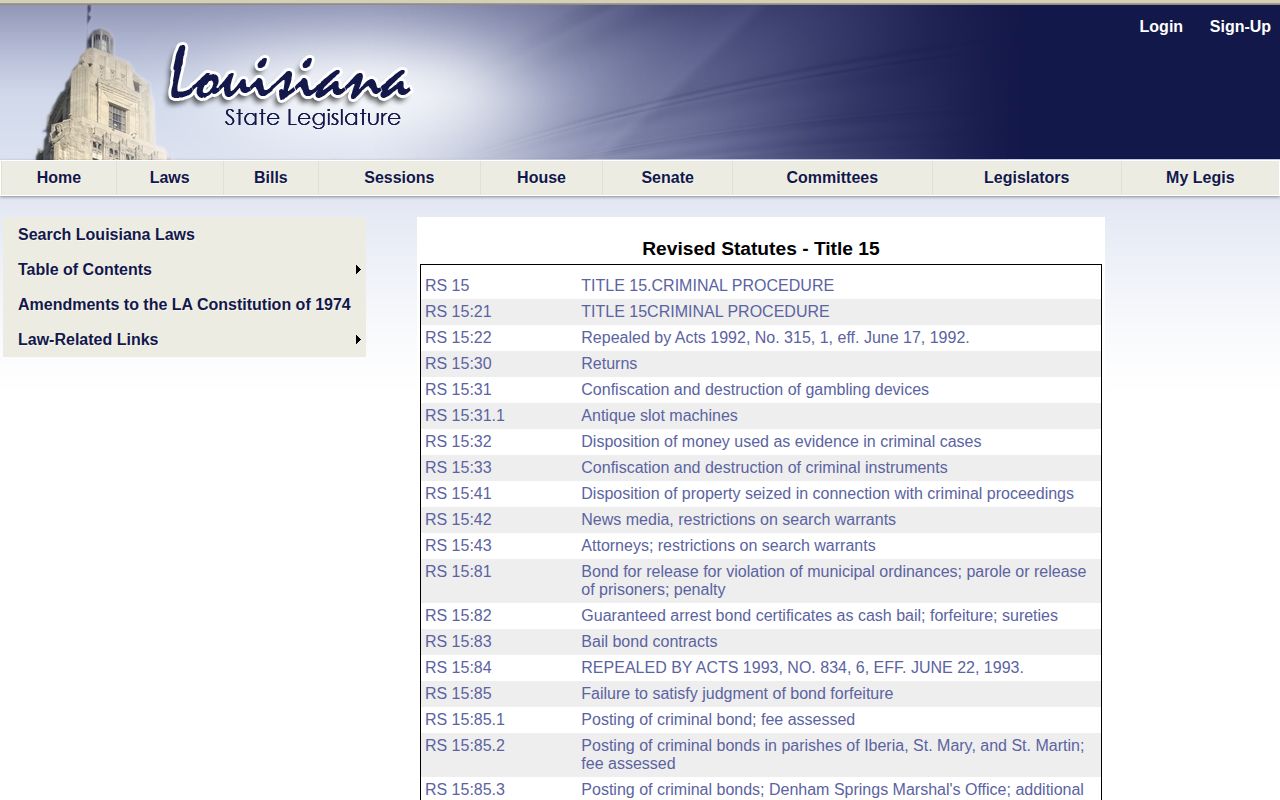
The source establishes Catahoula Parish's place in the regional system without exposing a child's name, image, custody status, or case record.
That structure is different from Catahoula Parish Jail, which books adults in local sheriff custody, and Catahoula Correctional Center, which has held mixed or contract populations. The regional center is mapped so families can select the right system. It is not included to encourage public identification of children.
The authority's seven-parish territory also explains why a Catahoula matter may not appear at a Catahoula-named building. Regional placement and court jurisdiction are different concepts. The court paperwork should identify the case and authorized contacts. A facility name found in an old message can become stale after a court or placement decision, so seek a current official confirmation.
Protected Catahoula Juvenile Records
Adult release records often include a booking number, admission time, release time, release type, destination, and related court number. Those public-record expectations do not carry over to a juvenile case. Access may be limited by the requester's role, the type of proceeding, and a court order. A staff member's refusal to discuss a case with the public is not evidence that the child remains confined.
- Authorized person
- A parent, guardian, lawyer, or other person whom law or the court permits to receive information.
- Placement
- A court-approved or agency-directed setting for care or supervision. It is not always a jail-like form of custody.
- Transfer
- A move between facilities, programs, or custodians. It does not necessarily mean return home.
- Release order
- The legal authority for a child to leave a detention setting under stated terms.
Keep identifying information out of public messages. A case number can help the correct office locate a matter, but it should be shared only through an official and secure channel. Do not post a child's status request on social media or send it to a commercial search service.
An authorized requester should also distinguish a status confirmation from a copy of a record. Staff may be able to explain the correct contact without disclosing the file. A formal record request may require a court procedure, proof of relationship, or counsel's involvement. Follow the instruction given for that case rather than adapting the adult public-record letter used for Catahoula Parish Jail.
Adult Release Searches Do Not Apply
Louisiana LAVNS and VINELink support adult jail and state-prison custody information. The Catahoula Parish Jail route combines a sheriff movement record with Seventh Judicial District minutes. DPS&C tools cover people in state prison and community supervision. ICE ODLS, BOP, and U.S. Marshals channels serve separate federal or immigration populations. None should be used as a workaround to expose a protected juvenile record.
A no-match in an adult database is expected when the population is outside that system. It proves nothing about a child's location or release. The adult Catahoula Parish release-record paths are useful for distinguishing agencies, but their public-search steps stop at the juvenile boundary.
Likewise, a booking photo request has no place in this route. The research specifically excludes juvenile names and images from the released-inmate project. A photograph, old report, or search-engine trace would not establish present custody and could bypass protections built into the juvenile process. The correct source remains an official participant speaking within the requester's lawful access.
Note: An adult database nonmatch cannot confirm a juvenile release, transfer, placement, or court result.
ICE Records Do Not Apply
Catahoula Correctional Center's historic ICE inspection record is a distinctive local custody issue, but it belongs to that facility's mixed-custodian analysis. It does not authorize an ICE search for a child connected with the Central Louisiana Juvenile Detention Center. ICE ODLS covers specified adult immigration detention records, not protected regional juvenile cases.
Using an unrelated federal locator can create a false conclusion and expose private identity data. An authorized juvenile contact should stay with the facility, court, or counsel named in the case. If another agency becomes legally relevant, that official source can explain the correct private route.
Safe Catahoula Juvenile Verification
Reliable confirmation comes from a positive, authorized source. That may be an official notice, a court communication, counsel, or facility staff speaking to a verified person. Rumor, a stale post, and a missing adult roster name fall below that standard. Record the date and office of any authorized call, but do not publish private details.
If information conflicts, stop. Ask counsel or the court which document controls. A release from secure detention can still include supervision, placement, or other court terms. “Released” should not be expanded beyond the actual order or notice. The child's privacy and safety remain more important than filling a gap in a public search.
Keep a private note of the office contacted, date, and response so an authorized professional can reproduce the check. Do not keep or circulate more information than the task requires. If immediate safety is at issue, use the emergency channel named by the responsible agency or call 911. Routine status questions should remain with the court, facility, or counsel instead of emergency services.