
Catahoula Parish Scheduled Release Dates
A projected release date is a calculation based on the sentence information that the legal custodian has received. It is not a promise that a person will walk out at that time. Louisiana Department of Public Safety & Corrections, Corrections Services uses the term “projected release date” for a date produced from its sentence computation. An actual release date records what occurred after staff received and checked all authority, resolved holds, and completed release processing.
The distinction is crucial in Catahoula Parish. A person at Catahoula Parish Jail may be awaiting trial, serving a parish term, or waiting for transfer. A state prisoner can be housed in a local or contract facility while Louisiana DPS&C owns the sentence record. Someone at Catahoula Correctional Center may instead be held for another parish, a federal authority, or, based on documented historic use, immigration custody. The building name alone does not select the right release-date system.
A transfer is not a community release. Nor is a parole grant the same as leaving custody. A detainer, meaning a request by another authority to take custody, can turn an expected local release into an agency pickup. The exact destination field in a movement record helps resolve that issue.
Find Catahoula Parish Release Dates
Start with the person’s full legal name and date of birth. Add a booking number, DPS&C number, or court docket when known. Similar names and aliases make a one-field match unsafe. The correct route then depends on whether the person is a parish detainee, a sentenced state prisoner, or someone held under another authority.
- Identify legal custody. Confirm the facility and whether the sheriff, Louisiana DPS&C, another parish, ICE, or a federal agency owns the record.
- For a state prisoner, use the official locator. The Louisiana DPS&C inmate-information page routes searches to LAVNS. Search broadly by name or ID before narrowing by location.
- Call for the computed date. The DPS&C automated locator at 225-383-4580 accepts a DPS&C number or a name and date of birth and can return a projected date when applicable.
- For a parish case, contact the jail and court. Catahoula Parish Jail can address the physical movement record. The clerk’s docket can show bond, sentence, credit for time served, dismissal, or a later order.
- Record the query date. Save the exact label, agency, and time checked. Then confirm the actual event with the custodian.
The official DPS&C page also lists the facility assignment and contact details available through its locator. The successful manifest capture below preserves that first-party entry point. It does not show a named person and should be used to understand the route, not as proof of anyone’s status.
View the Louisiana DPS&C locator instructions before calling or opening LAVNS.
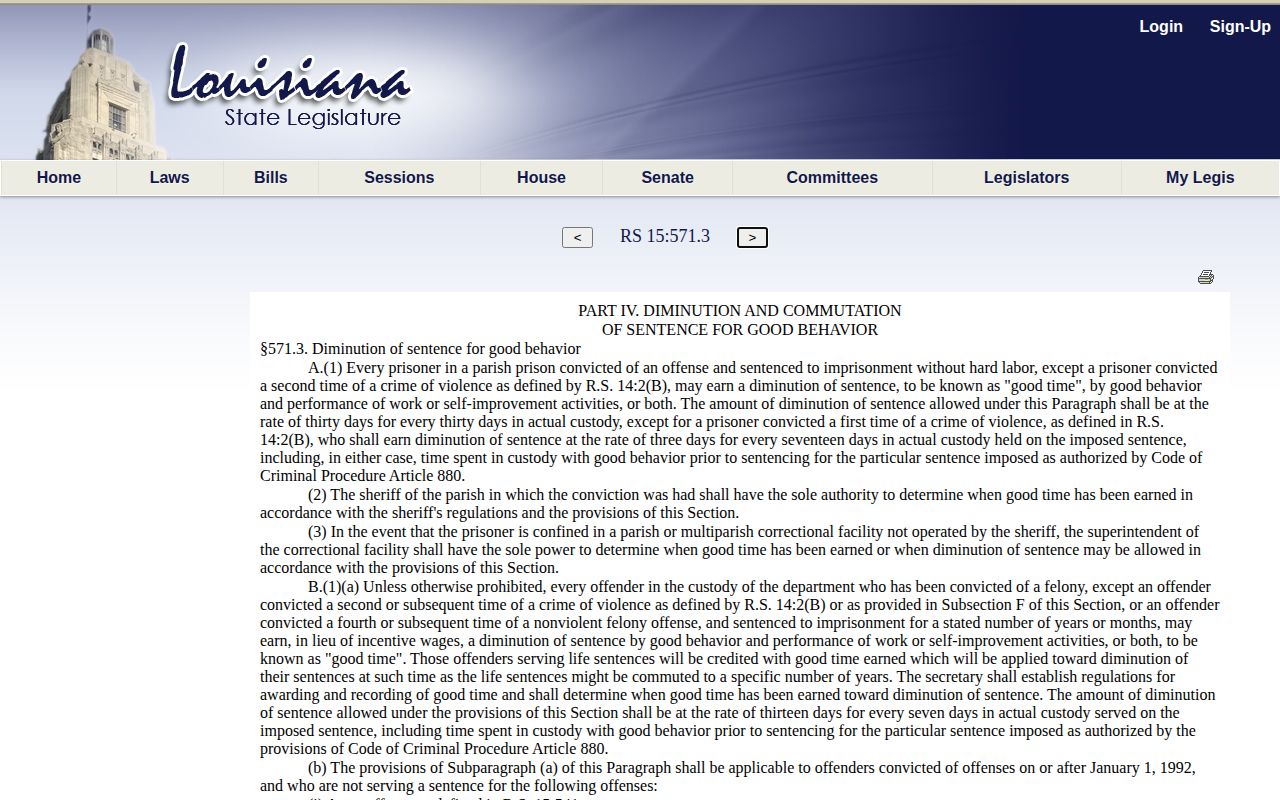
The agency instructions explain why a statewide search is the right next step when someone has moved out of a Catahoula Parish facility but remains in Louisiana custody.
For a full named-person search path, the Catahoula Parish released-inmate lookup separates a missing jail result from a documented release.
Catahoula Parish Date Computation
A defensible Louisiana sentence calculation begins with the court’s imposed term and the lawful start date. Staff then determine which credit applies for time already spent in custody, whether terms run at the same time or one after another, which good-time class governs, and whether an exclusion applies. Good time is also called diminution of sentence. It reduces the custodial portion when the person remains eligible and earns the credit.
Paperwork matters. DPS&C says no date may be available while it waits for official sentencing documents or while the computation is incomplete. The affected prisoner receives a Master Prison Record that reflects sentence calculation. Broader past, present, and future prisoner files are confidential under R.S. 15:574.12, so a public caller should use the locator for the calculated date rather than expect the full worksheet. The DPS&C time-computation information line is 225-342-0799.
- Projected release date
- The agency’s current estimate based on its sentence and credit data.
- Presentence credit
- Qualifying time spent in custody before sentence, applied under the governing judgment and law.
- Concurrent terms
- Sentences that run at the same time.
- Consecutive terms
- Sentences that run one after another.
- Discharge
- The end of the relevant custody or supervision obligation, as recorded by the responsible agency.
Limited public facts can still be requested from DPS&C. R.S. 15:574.12(G)(1)(a) makes general information such as age, offense, conviction date, sentence length, disposition, and discharge date public upon request. That narrow request is different from seeking the whole prison record.
A person checking their own Louisiana custody history has another route. Louisiana Administrative Code Title 22, Part I, Section 101 allows a former offender or offender to request a Letter of Incarceration. Its minimum fields include the person’s name, incarceration and supervision dates, admission date, release date, and last incarceration location. This subject-access document can be stronger proof of personal history than a screenshot of a changing locator. It is not a live prediction tool, and it should not be requested as a substitute for the public locator when checking someone else’s projected date.
Note: A court sentence explains legal authority, while the correctional movement record shows when that authority was carried out.
Offense Date Changes Good Time
The date of the offense selects the Louisiana good-time framework. This is the key Catahoula Parish computation quirk from Research Section 19, Angle O. For qualifying felony offenses committed on or after August 1, 2024, R.S. 15:571.3.1 allows up to 15 percent diminution for good behavior. It excludes specified sex-offense and habitual-offender sentences, addresses other program credit, bars good-time credit on presentence article 880 custody for that cohort, and makes credit subject to forfeiture.
That maximum is the source of the current “85 percent” shorthand. It is not a guaranteed release at 85 percent. Eligibility, earned credit, forfeiture, the judgment, and other holds can all change the result. A person with an excluded sentence does not gain the rule merely because a rough calendar calculation reaches that date.
Earlier offenses remain under R.S. 15:571.3. Its rules differ by category. The research identifies an eligible parish prisoner sentenced without hard labor who may earn 30 days of diminution for every 30 days in actual custody, while an eligible first-time violent offender may earn three days for every 17 days. The latter rate also produces an 85 percent ratio if all credit is earned, but the legal route is not the same as the newer statute.
The manifest image below corresponds to the official current statute. Read the statute tied to the offense date and rely on DPS&C’s calculation for the person, not a general percentage.
Open Louisiana’s current diminution statute to review its scope and exclusions.
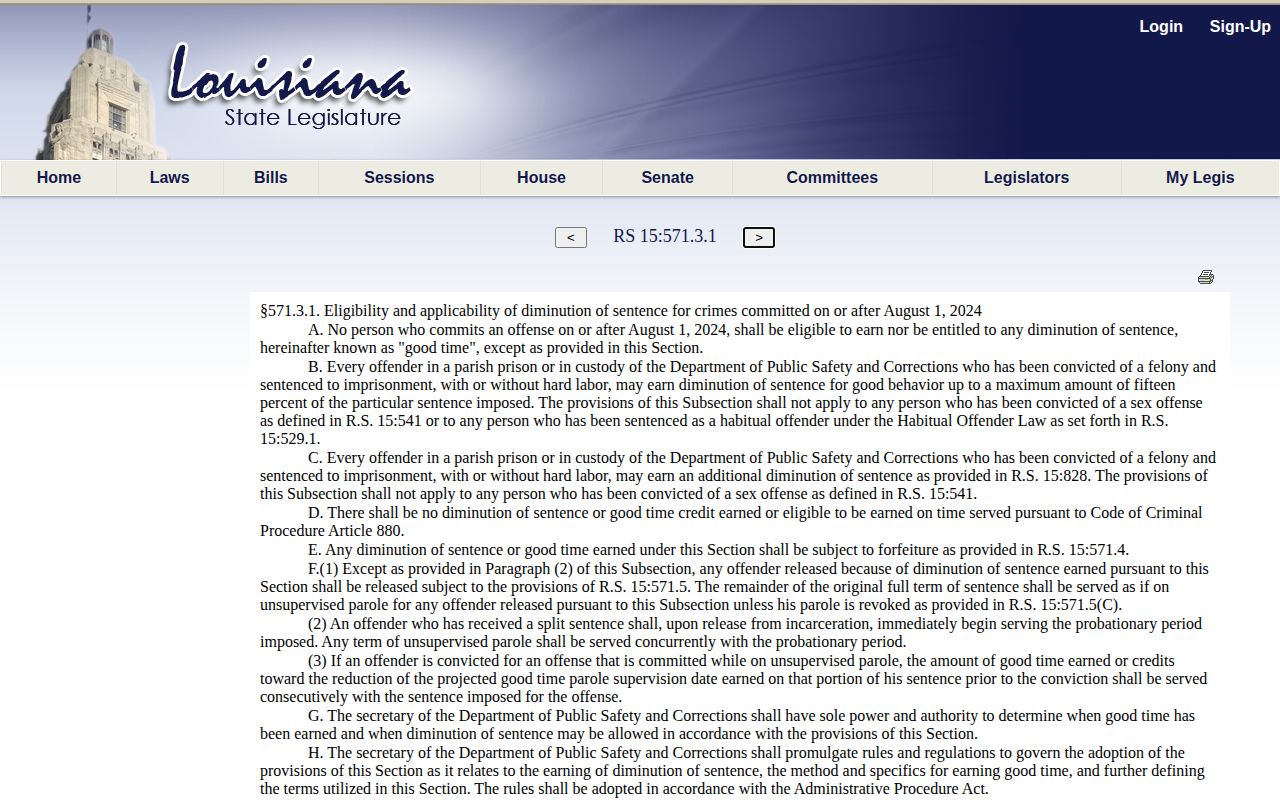
The visible legal text is a starting point for the date class. The commitment and official computation still control the individual answer.
Why Catahoula Release Dates Move
A date can change even when the original entry was accurate at the time. Courts correct commitments. Staff add qualifying credit. Disciplinary decisions can forfeit good time, and later action can restore some credit. Another sentence may be made consecutive. A parole panel can deny, defer, grant, or later revisit an action. Each change affects a different part of the projected release calculation.
| Factor | Effect on the date | Best check |
|---|---|---|
| Court paperwork | A corrected term, start date, or sentence structure changes the base calculation. | Seventh Judicial District minutes and commitment |
| Good-time action | Earned, forfeited, or restored credit can move the projected date. | DPS&C computation route |
| Detainer or hold | Release from one custody may become transfer to another agency. | Holding agency and movement record |
| Parole decision | Eligibility or a grant may change the path, but does not prove gate release. | Board result, LAVNS, and supervising office |
| New judgment | A new or revoked sentence can extend custody. | Court docket and custodian |
R.S. 15:571.4 governs forfeiture of diminution. Parole eligibility under R.S. 15:574.4 is only a threshold for consideration. Neither an eligibility date nor a favorable hearing result proves that the person entered the community.
Catahoula Parish Pretrial Release Dates
A person held before trial generally has no sentence-based projected release date. Release can turn on a bond being posted, a recognizance order, dismissal, a hearing, completion of another agency’s hold, or transfer. The Catahoula Parish Clerk of Court record explains the judge’s authority, but it may not show the exact time jail staff completed the physical release.
Use two records. Ask the clerk for the docket and minutes that show the bond order, dismissal, sentence, time-served credit, or other disposition. Ask Catahoula Parish Jail for the booking and movement entry that gives the event date, time, type, and destination. If the person was sent to Louisiana DPS&C or another parish, absence from the local roster reflects movement, not freedom.
Why is there no release date? The person may be unsentenced, the agency may still await court papers, or a projected field may not apply. Call the legal custodian with two matching identifiers.
Note: Catahoula’s official Arrests page had no usable search during research, so a missing web record is weak evidence.
Confirm Catahoula Parish Actual Release
Check the exact agency label and timestamp close to the expected date. Louisiana LAVNS can show state custody or community supervision and is updated on a stated 24-hour cycle, so a recent event may not appear at once. A custody-change alert can also mean transfer, escape, return, or another status change. Read the full event before drawing a conclusion.
The Catahoula Parish VINELink release check explains one-person searches and alerts. For final proof, ask the sheriff or DPS&C for a dated transaction or discharge fact. If a state result shows parole, the person is outside prison but still serving the sentence under supervision. “Discharged” generally marks the end of the relevant obligation, but only the live agency label should be quoted.
Federal and immigration dates require separate systems. BOP can show a federal release date for covered sentenced prisoners. ICE ODLS has a limited window for people released from ICE custody and a nonmatch does not prove release. The U.S. Marshals Service has no comparable public released-person locator. Identify the custodian first, preserve the query date, and verify any apparent release through the source office.